

Why Ethical Bear Guiding Demands Continuous Consent- One Sit at a Time
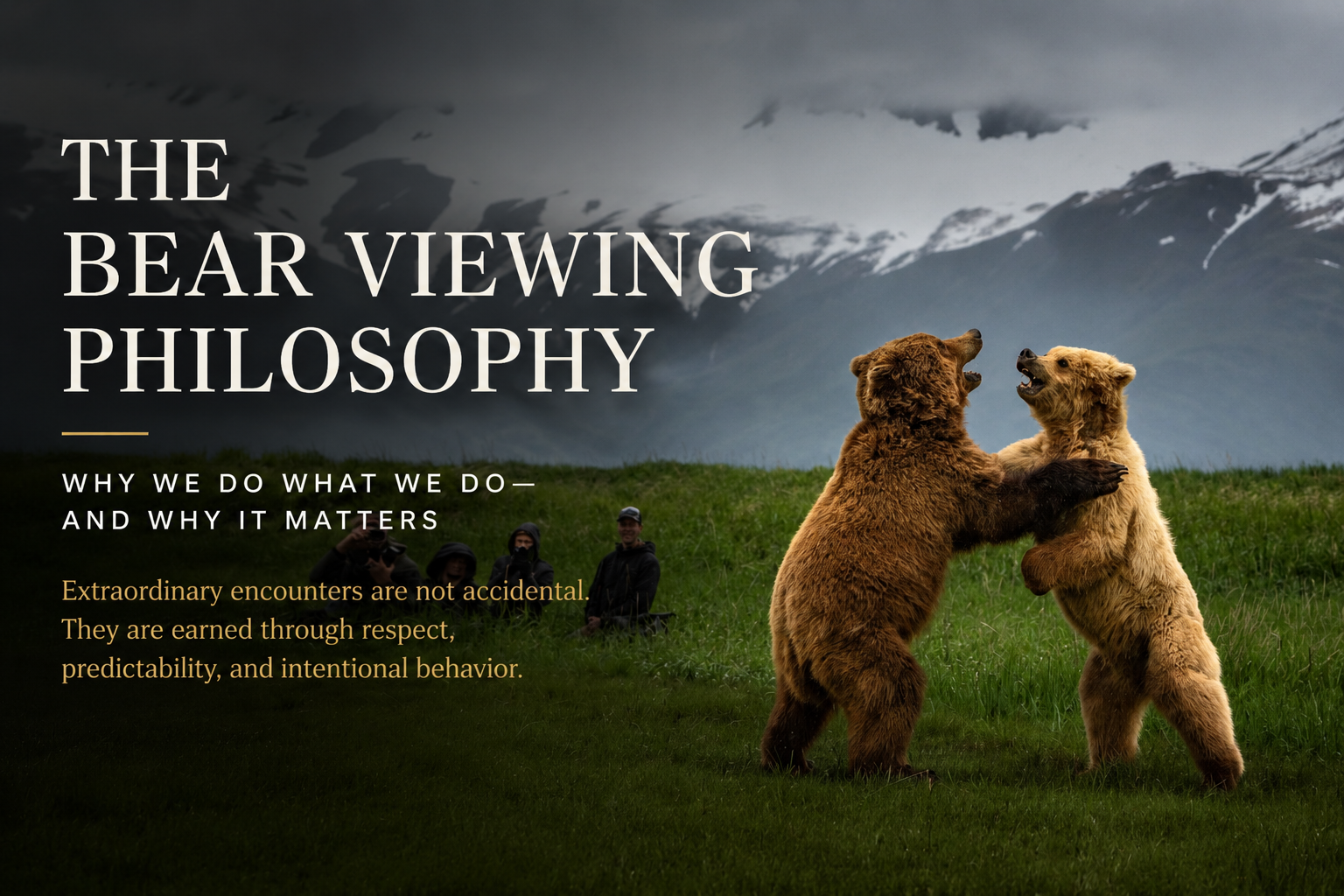
Coastal brown bears interacting in Alaska’s Bear Coast landscape, illustrating the principles of ethical bear viewing, bear behavior, and responsible wildlife guiding.
After more than twenty-five years guiding, photographing, and studying Alaska's coastal brown bears, I've come to believe that one of the greatest misconceptions about them is also one of the most widespread.
Sit quietly on a bucket in a sedge meadow on Alaska's Bear Coast and something remarkable can happen. A wild brown bear may continue feeding fifty yards away as if you simply belong there. There are no fences. No vehicles. No bait. No tricks.
Just a completely wild bear making a decision.
For many people, the explanation seems obvious: "There are so many salmon here that the bears simply don't care about people." It's one of the most common things I hear.
It's also completely wrong.
Food certainly matters. Salmon, sedge, clams, and berries allow these bears to grow larger than almost anywhere else on Earth. But abundant food isn't what makes these extraordinary encounters possible.
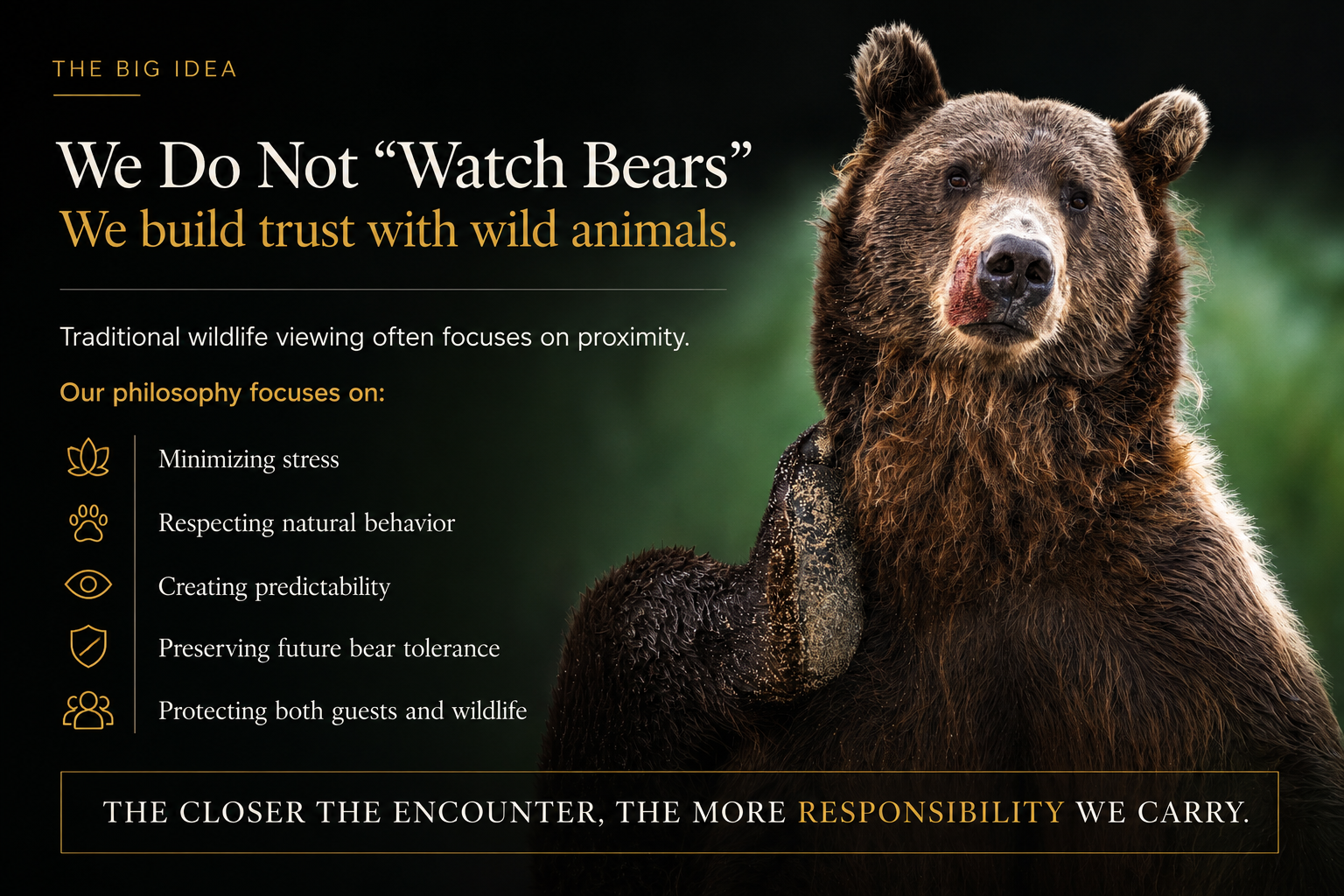
The real story began thousands of years ago, and understanding it changes everything about how we must behave around them today.
The Bear Coast Built Bear Society
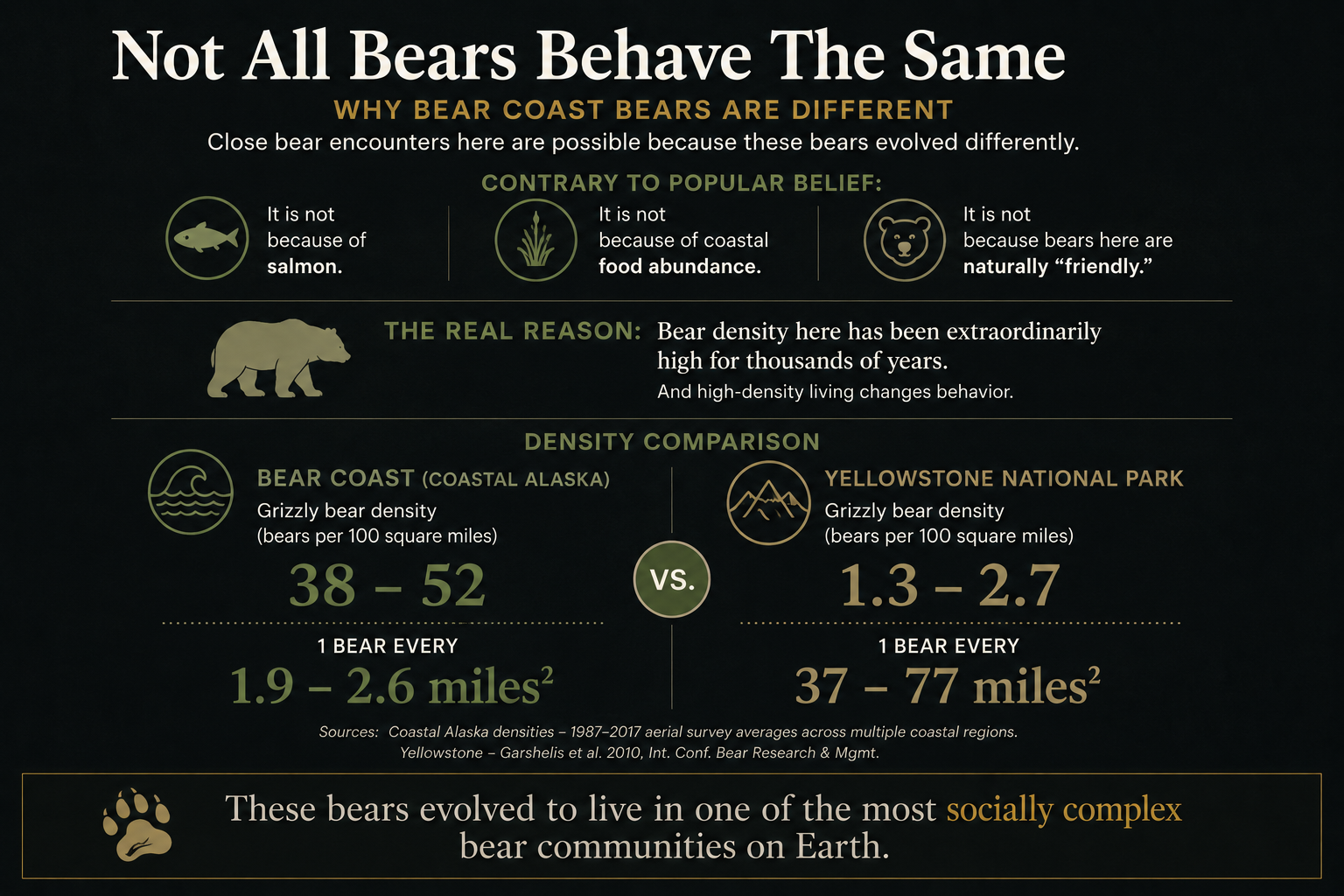
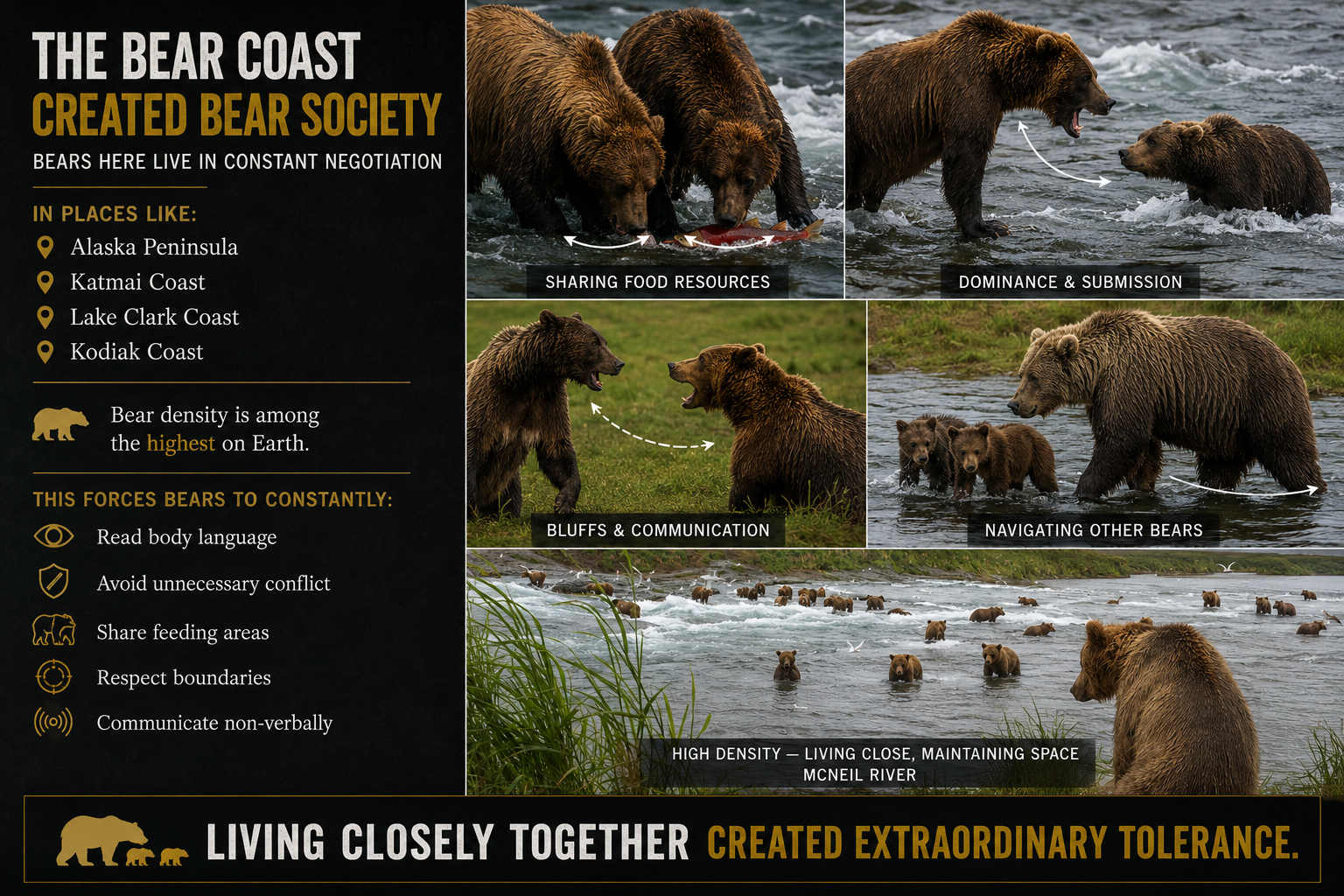
The coastlines stretching around Kodiak and down the Bear Coast support some of the highest concentrations of brown bears anywhere on Earth. Imagine living your entire life surrounded by other bears. Every day means negotiating fishing holes, sharing sedge meadows, crossing trails, passing dominant males, and avoiding mothers with cubs.
Unlike interior bear populations, these coastal bears rarely have the luxury of avoiding one another. Conflict is physically expensive; communication is cheap. Over thousands of years, natural selection favored bears that could successfully interpret body language, recognize intent, and resolve conflict without unnecessary confrontation.
The result is something remarkable.
Bears evolved into extraordinarily sophisticated communicators. They live in one of the most socially complex animal societies on Earth.
Every Movement Means Something
Watch two coastal brown bears approach one another. They rarely walk directly at each other. Instead, they drift, pause, angle, graze, stop to investigate a scent, and change direction. To an untrained human eye, it can appear random.
It isn't. Every movement is a deliberate communication:
"I'm feeding."
"I'm not interested in conflict."
"You can pass."
"I'm giving you space."
Non-verbal communication is paramount to survival in this society.
The moment we enter a bear's world, we become part of that same conversation. Whether we realize it or not, we are communicating with every single step we take.
Bears Are Constantly Asking One Question: “Are You a Threat?”
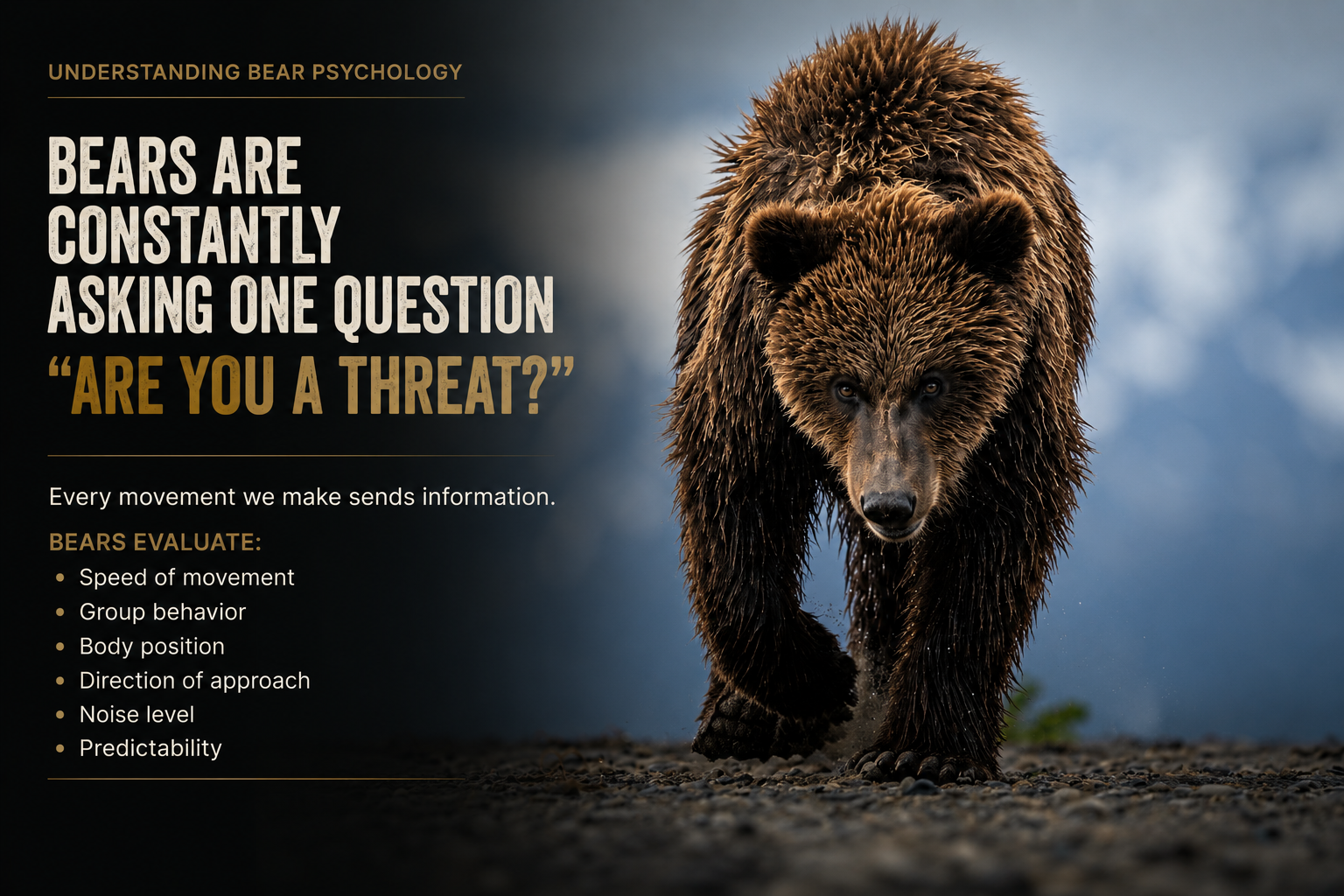
People often ask me what a bear is thinking when it notices us. I don't think it's asking, "Is that a human?" I think it's asking something much simpler:
"Should I be concerned?"
Everything we do contributes to the answer. How quickly we move, whether we stay together, how directly we approach, whether we pause, and whether we remain predictable. To us, these can seem like small details. To a bear, they are critical data points.
If humans walk into this complex ecosystem without knowing the language, the conversation breaks down instantly. Fear takes over, boundaries are violated, and safety evaporates.
This is why true bear viewing cannot happen without a professional guide.
A true bear guide isn't there to show you where to point your camera, but to act as a translator. It takes years of immersion to read the micro-expressions of a 1,000-pound apex predator. Without an expert leader who understands how to speak "bear," entering their space isn't just reckless—it is unethical.
A Philosophy Built Across Generations
The principles presented here weren't created overnight, nor were they developed by any one guide.
They are the product of decades of observation, discussion, and refinement.
Long before ethical bear viewing became part of the broader conversation, a small number of pioneering guides and managers at McNeil River State Game Sanctuary were quietly demonstrating that people could coexist with extraordinary concentrations of wild brown bears without altering their natural behavior. At roughly the same time, many of those same lessons were being discovered and refined at Brooks Falls in Katmai National Park, where managers and rangers faced similar challenges of balancing world-class wildlife viewing with the long-term welfare of the bears.
Brad Josephs and Drew Hamilton each spent years immersed in the philosophy that emerged from McNeil River, while my own education was taking shape at Brooks Falls. Although our paths began in different places, they were leading toward the same conclusion: the best bear viewing experiences happen when humans adapt to bears—not when bears adapt to humans.
As our careers eventually came together, so did our conversations.
Over thousands of days in the field, we challenged one another's assumptions, compared observations, debated difficult situations, and continually refined how we approached bears and how we taught others to do the same. We weren't interested in finding ways to get people closer to bears. We were trying to answer a much more important question:
How do you consistently create extraordinary bear encounters while asking as little of the bear as possible?
Slowly, we realized we were all describing the same philosophy.
Together, we distilled those decades of collective experience into five guiding principles—not rigid rules, but a practical framework for making better decisions in the field. Every principle shares the same foundation: the responsibility always belongs to the guide. It is our job to read the bear, adjust our behavior, and exercise the patience and discipline required to let every encounter unfold on the bear's terms.
The Five Principles of Bear Consent
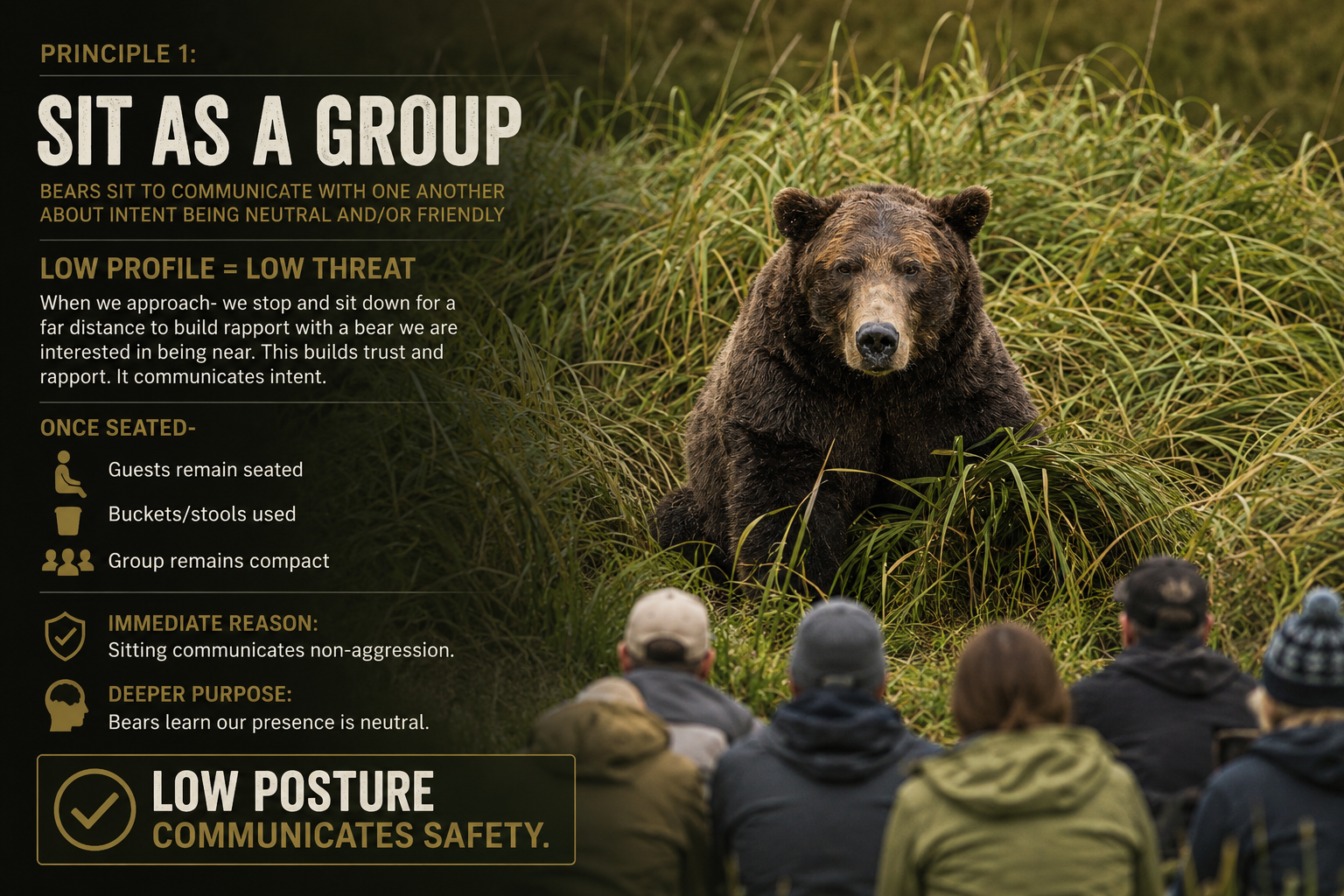
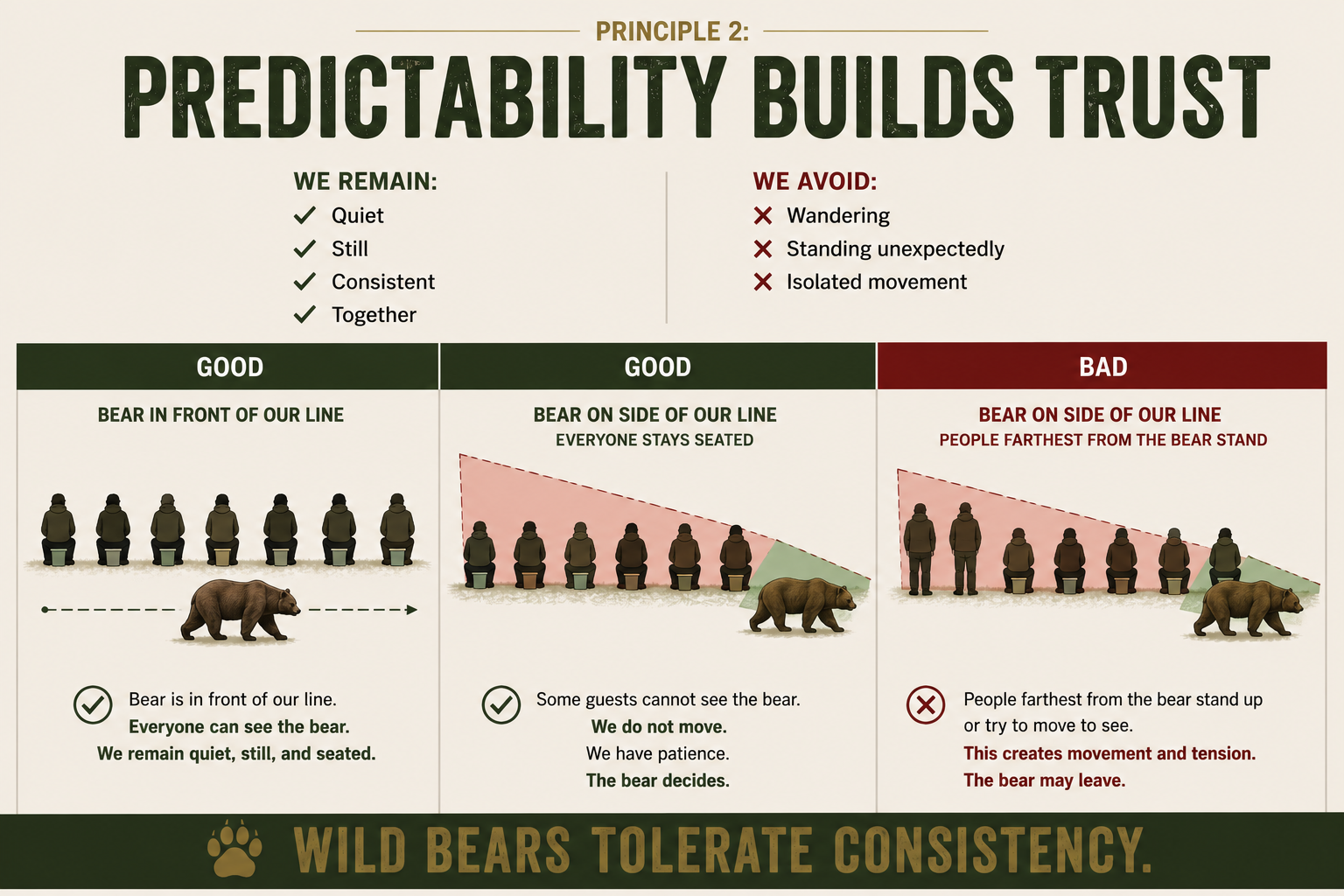
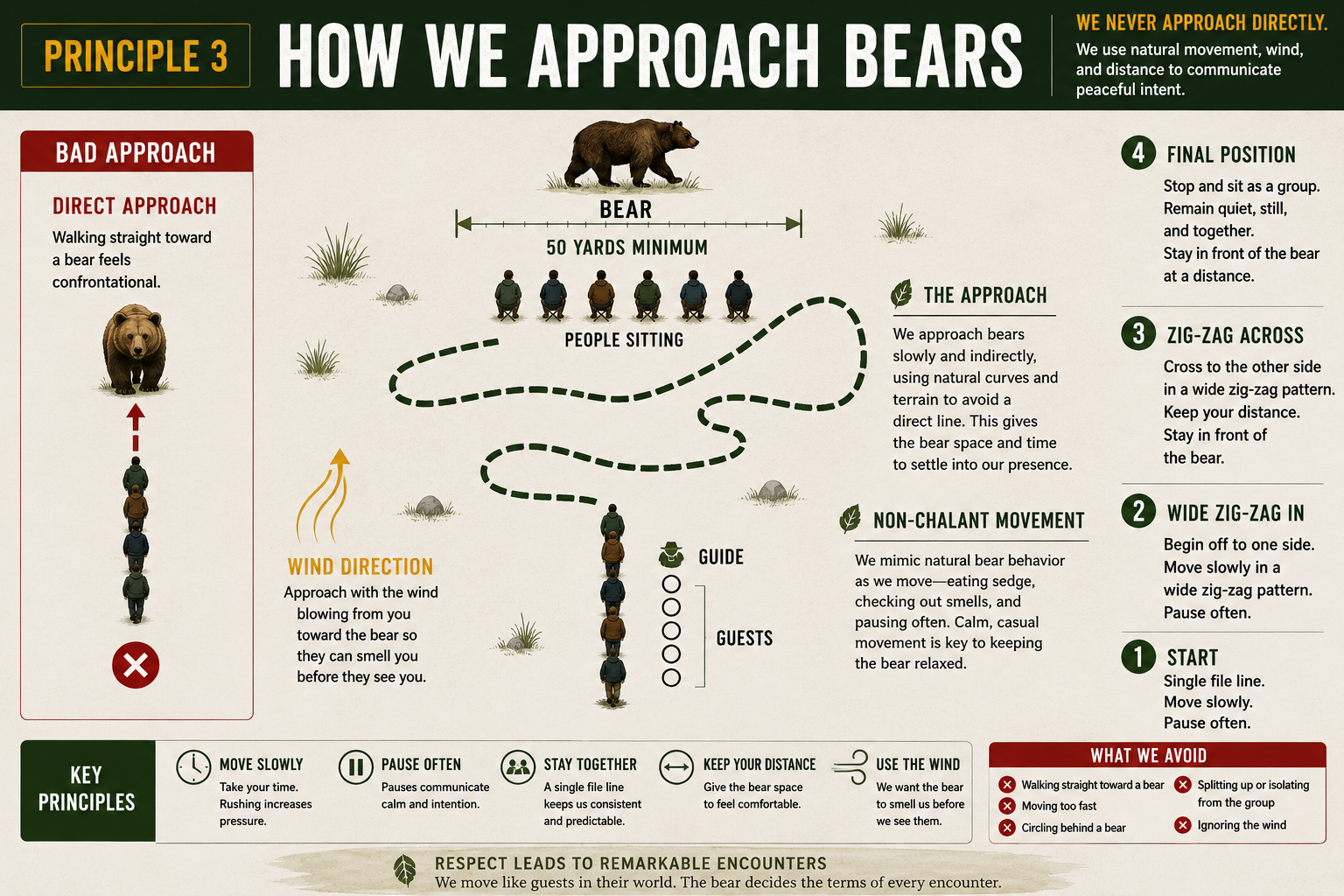
At the absolute core of this philosophy is a single immutable truth: A bear must give explicit consent for an approach, and it must keep consenting during the viewing at all times.
Consent is not a one-time permission slip; it is a fluid, continuous conversation. If at any point the bear withdraws that consent, the encounter is over. To maintain that active consent for the betterment of the bear and the safety of the people, an expedition leader must strictly enforce these five principles.
1. Sit Together
Long before we are close enough for photography, a guide will stop the group and have everyone sit. Buckets and stools aren't about comfort; they are communication. A seated group presents a low, non-threatening profile. Movement decreases, and the group becomes a predictable, calm, single unit. To a bear, we are no longer a chaotic collection of moving unpredictability—we are simply a static part of the landscape.
2. Be Predictable
Bears are masters of pattern recognition. When a guide keeps a group tightly together, and resists the temptation to constantly reposition for a "better angle," the bear quickly understands that nothing unexpected is going to happen. Predictability builds trust. Randomness creates anxiety.
3. Move Like a Bear
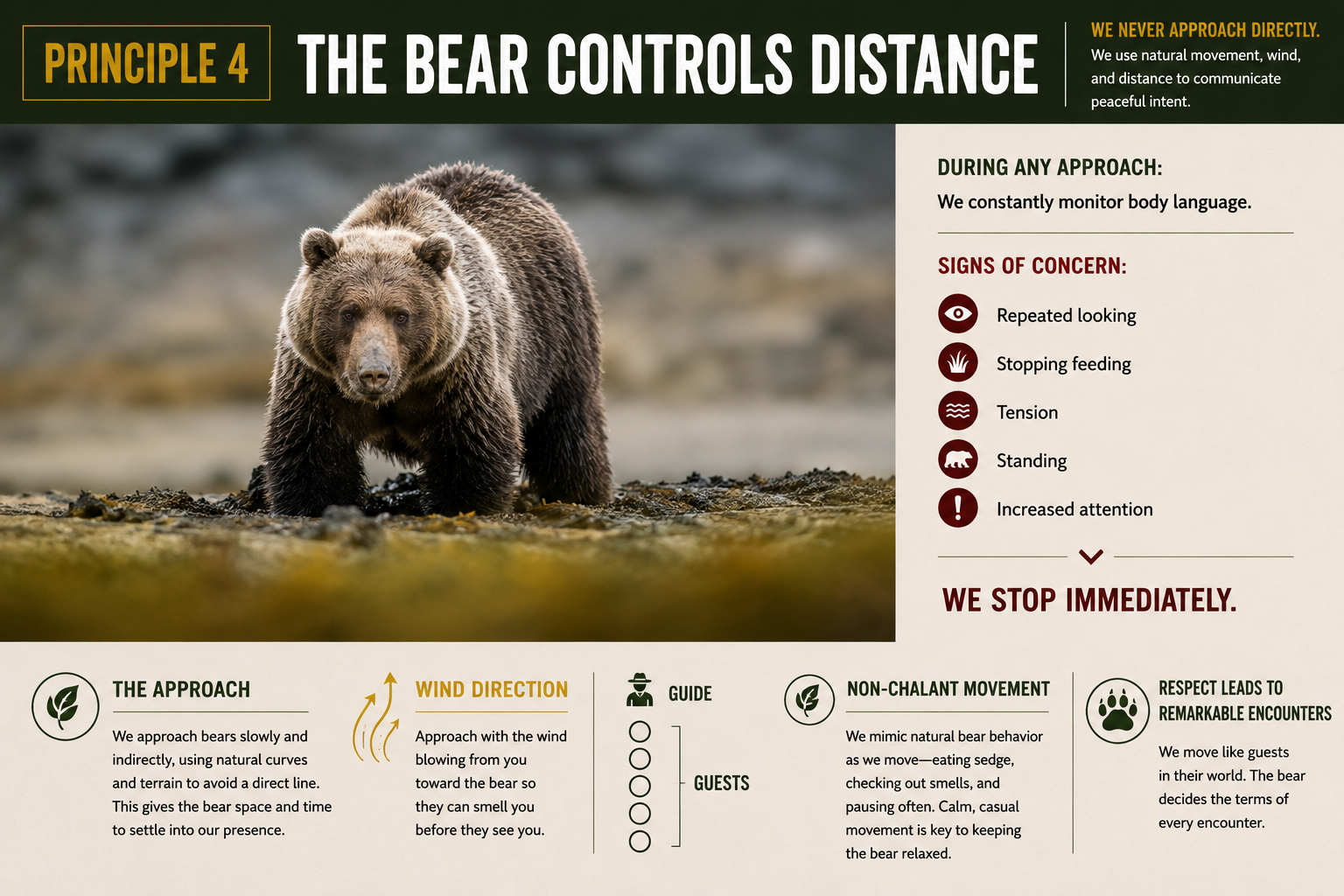
A professional guide rarely walks directly toward a bear. Instead, they move in broad zig-zags and sweeping semi-circles, pausing often, and letting the wind carry our scent ahead of us so there are no surprises. Think about how a bear moves through a sedge meadow—it grazes, stops, investigates smells, and drifts. Its body language says, "I have nowhere important to be." That is exactly what a guide replicates. Our movement must feel familiar to the bear, never foreign or predatory.
4. The Bear Controls Distance
This is the operational definition of consent. The bear decides. If a bear stops feeding and stares at us for more than a few seconds, we stop and we sit. If it shifts its body dynamic away from us, we stop and we sit. The goal of a guided trip is never to force proximity; it is to accurately read the distance the bear requires to feel entirely safe, and to respect that boundary without exception.
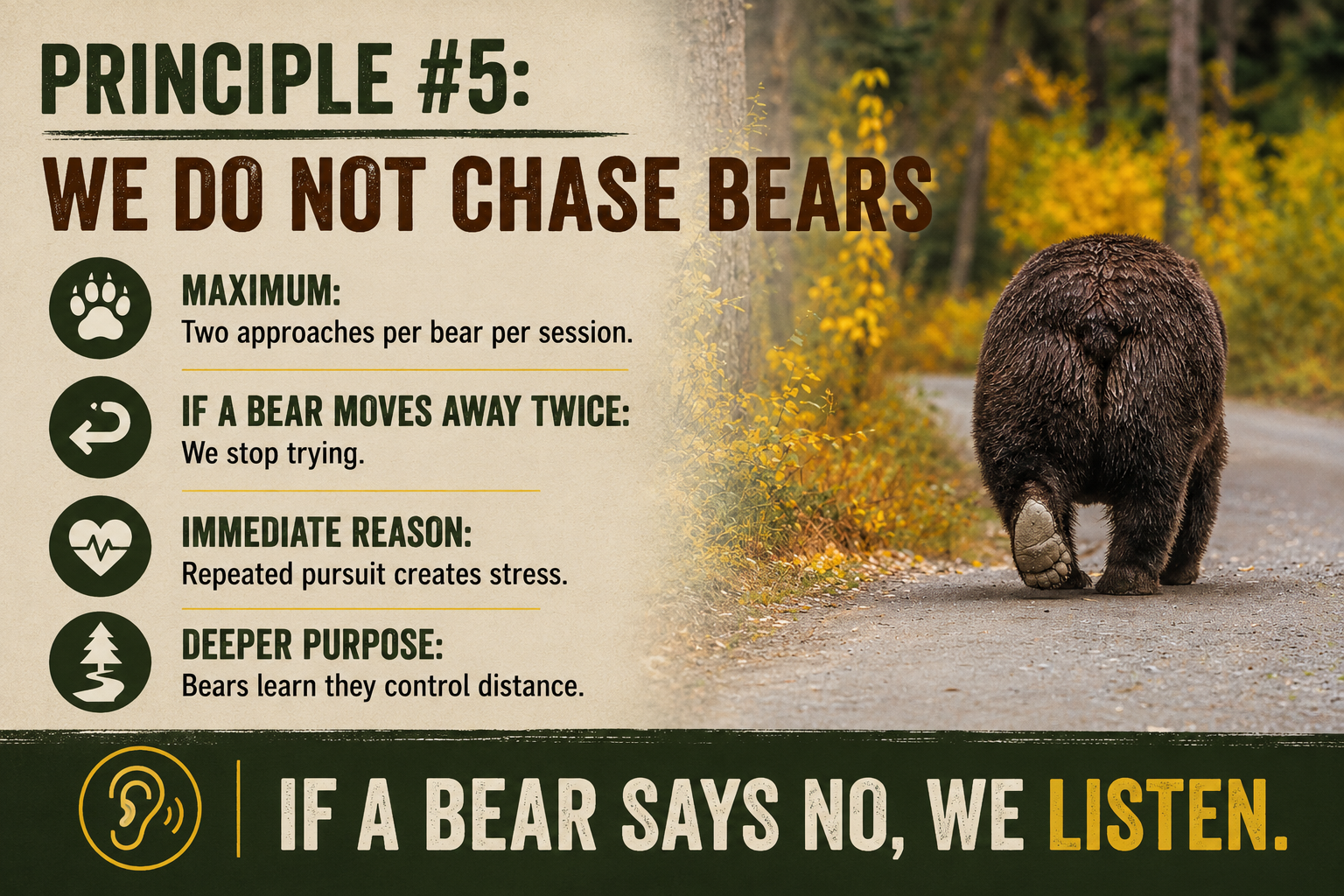
5. We Never Chase Bears
If a bear walks away from us twice during a viewing session, the encounter is finished. Could we walk faster and pursue them? Physically, yes. Ethically, absolutely not. Repeated pursuit changes the conversation from a request for consent into a pursuit. The greatest gift a guide can give a wild bear is the freedom to choose—and ironically, knowing they have the freedom to leave is exactly why they choose to stay.
Respect Creates Extraordinary Encounters
People often ask how it's possible to photograph wild brown bears from such intimate distances.
The answer is a respect that should e fiercely guarded by experienced guides and repeated thousands upon thousands of times.
Every remarkable bear photograph I have ever been apart of began long before someone pressed the shutter. It began with a bear assessing our group, reading a guide's body language, and deciding that our presence wasn't worth worrying about.
That decision belongs entirely to the bear. Our responsibility—as guides leading guests into the wild—is simply to behave in a way that deserves it.
We don't get close to bears because they tolerate humans. We get close because we have committed our lives to learning how not to violate the trust they have evolved over thousands of years. By making these five principles the non-negotiable standard of guided bear viewing, we ensure something far more important than great photographs.
We ensure a future where wild bears continue choosing to trust us.
The Escalation Ladder: How Conversations Prevent Catastrophe.
To understand how continuous consent works in practice, you have to understand what happens when a bear decides to walk closer.
Many people assume that if a 1,000-pound brown bear approaches a group, the guide immediately pulls out a deterrent. In reality, an ethical guide relies on a highly structured, non-verbal system of micro-escalations designed to de-escalate the situation without alarming the animal.
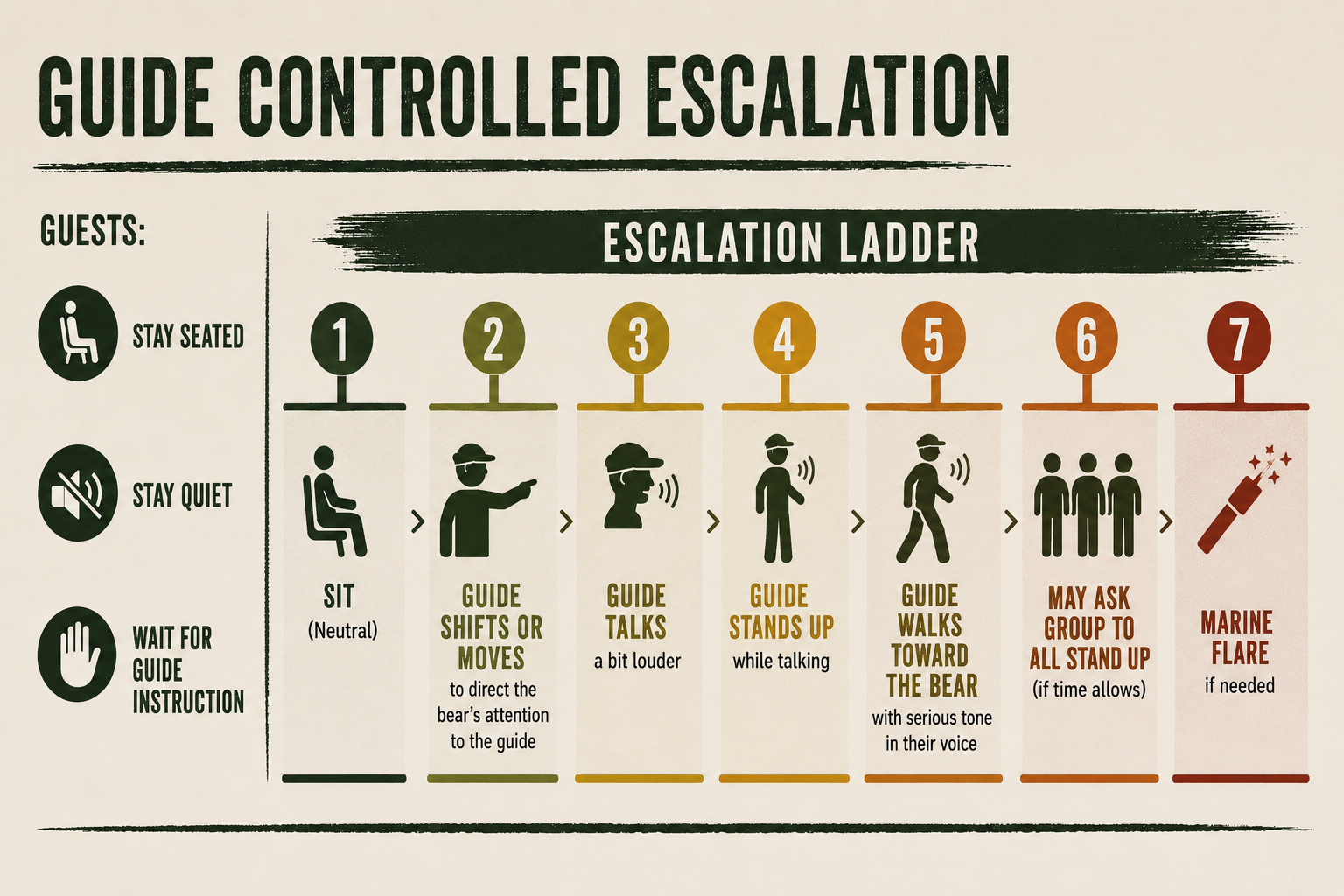
Under the Guide Controlled Escalation Framework, there is a strict 7-step "Escalation Ladder" that dictates how a professional guide manages a close encounter.
For the guests, the instructions never change:
Stay Seated
Stay Quiet
Wait for Guide Instruction
By staying anchored to the ground, the guests remain a predictable, low-profile element of the landscape. This leaves the guide free to communicate clearly with the bear using a dialed-in progression of cues:
SIT (Neutral): The baseline. Everyone is low, calm, and non-threatening.
GUIDE SHIFTS OR MOVES: The guide makes a deliberate physical movement to quietly draw the bear’s attention away from the group and strictly onto the guide.
GUIDE TALKS: The guide speaks a bit louder, using a calm but assertive voice to acknowledge the bear and establish a presence.
When a group is properly seated, the communication remains relaxed. Because it was started from a position of total neutrality, the conversation almost never goes past Step 3. The bear reads body-language, understands the boundary, and simply moves on.
The Fatal Flaw of Standing Groups
But what happens when a guide allows an entire group to stand up from the beginning?
The escalation process starts automatically at Step 4.
Step 4 on the Escalation Ladder is where the guide is forced to stand up to change the dynamic. If your group is already standing, you have completely erased your neutral baseline. You have thrown away Step 1, Step 2, and Step 3 before the bear has even taken a step toward you.
When you start an encounter standing up, you are already broadcasting an elevated, assertive presence. Because you have nowhere lower to go, the guide's options are immediately compressed. If that bear gets curious or tests a boundary, the guide has to jump straight into high-stress actions:
GUIDE WALKS TOWARD THE BEAR with a serious tone.
MAY ASK GROUP TO ALL STAND UP (if they weren't already).
MARINE FLARE or other high-level deterrents.
This structural shortcut is exactly how things go sideways in the field. When you skip the foundation of a seated, neutral group, the non-verbal dialogue becomes incredibly tense. Bears get flared, pepper-sprayed, or shot—and people get hurt or killed—not because the bear was inherently aggressive, but because the human group failed to speak the language of de-escalation from the start.
Sitting down isn't a matter of guiding style or personal preference. It is a foundational ethical practice.
If an operation routinely allows guests to remain standing around bears, one of two things is true: they either don't understand the behavioral impact that standing humans have on bears, or they've become complacent enough to ignore it. In either case, the bears are paying the price for a preventable mistake.
The Bigger Picture: We Are Borrowing This Place
As part of a larger Coexistence Blueprint, the extraordinary bear encounters we enjoy on the coast are a privilege, not a right. We must always remember a fundamental truth:
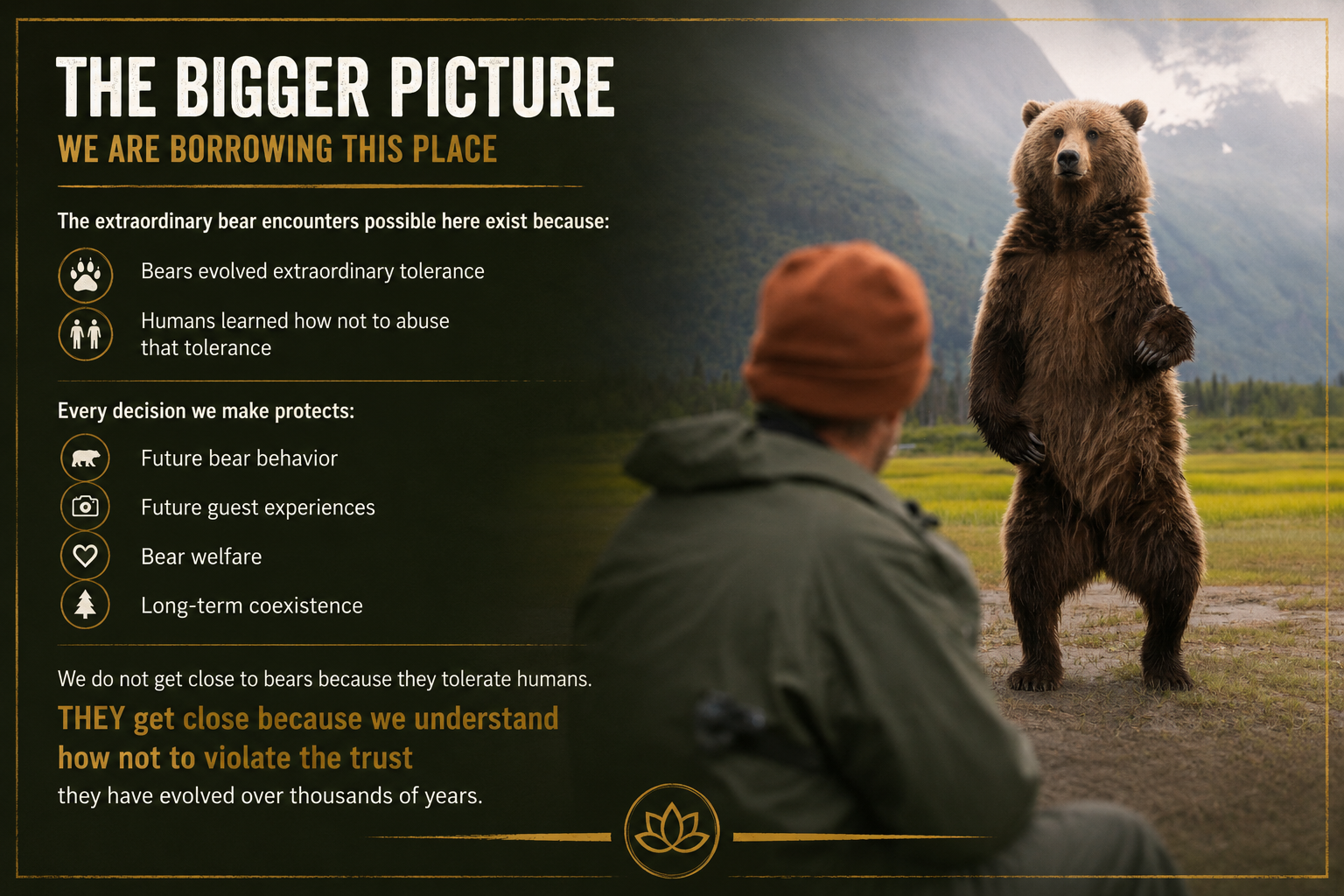
We are borrowing this place.
The reality of the Bear Coast exists because of a perfect, fragile balance: bears evolved an extraordinary level of social tolerance over thousands of years, and humans have learned how not to abuse that tolerance.
Every single micro-decision a guide makes in the field—from forcing a group to sit on buckets to stopping a direct approach—serves a multi-generational purpose. It protects future bear behavior so they don't become conditioned or defensive. It protects future guest experiences so others can witness these wild spaces. Most importantly, it protects the welfare of the bears and ensures long-term coexistence.
We don't get close to these magnificent animals because they merely tolerate our presence. They choose to allow us nearby because we understand how not to violate the ancient trust they have built into their society.
True bear guiding means earning and protecting that trust one sit at a time. Every sit is a decision. Every decision either builds the bear's confidence in us or erodes it. It is our job as guides to ensure that the conversation of consent never breaks down.
It should also be the responsibility of every bear viewer to expect—and insist—that their guide follows these principles. Ethical bear viewing isn't a matter of style or personal preference. It is a professional standard. When guides abandon these principles, it is the bears that bear the consequences.